
Talk to an Expert
Six research-backed statistics on the real-world business impact of digital signage — from sales uplift and attention capture to order value and perceived wait times. Every figure here comes from a published study, with the original source linked. No invented numbers, no marketing fluff.
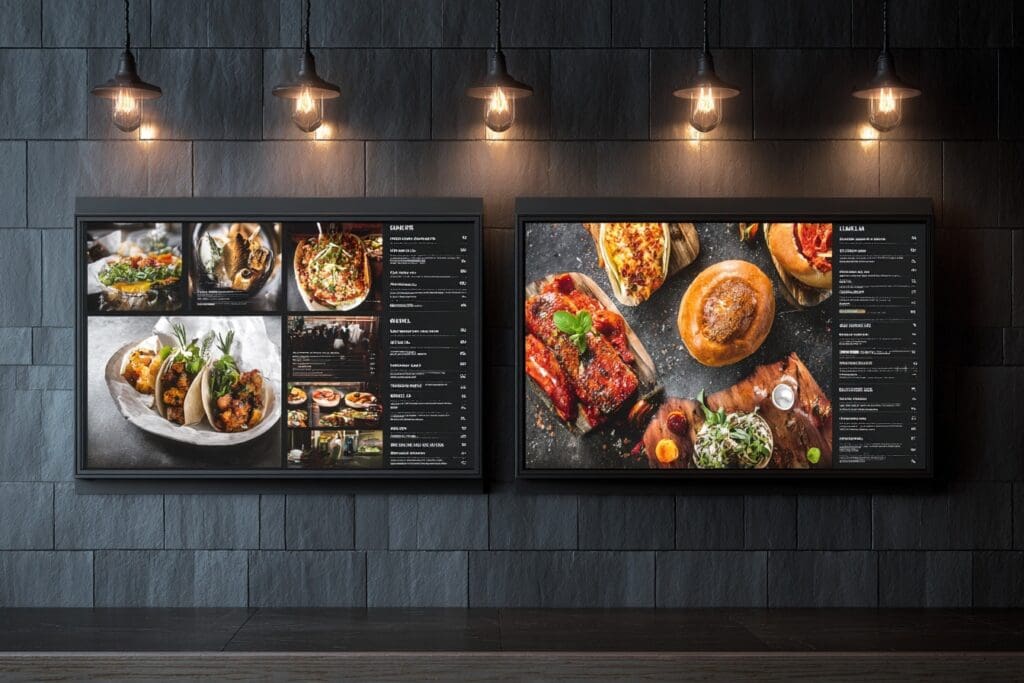
If you’re running a restaurant, café, retail shop, hotel, or any customer-facing business in Ireland, you’ve probably wondered whether digital signage is actually worth the investment — or whether it’s a nice-to-have you can put off for another year.
The research gives a clear answer. Over three decades of industry studies — from Arbitron audience measurement work in the 2000s to QSR operator data published in the 2020s — consistently show that digital displays outperform static signage across every measurable metric: sales, attention, recall, order value, and customer experience.
Below are six of the most robustly sourced statistics, each with the original study linked, an explanation of what the research actually found, and a practical note on what it means for Irish businesses in 2026.
Statistic 01 — Sales Impact
The 29% figure originates from the Networld Media Group Digital Menu Board ROI Study, which gathered data from both digital menu board providers and end-users across the QSR and fast-casual restaurant sector. The study found that operators consistently reported a 3–5% uplift in sales from digital menu boards over static alternatives — and a 29% faster content turnaround time, reducing the lag between a promotional decision and its appearance on screens.
Separate research by Restaurant Technology Review (2023) confirmed similar findings, with small restaurants adopting cloud-based digital signage achieving a 22% sales increase alongside a 37% reduction in print costs. The WAND Digital ROI Study found a 2% incremental sales increase for an average single-location implementation — smaller, but still meaningful, and the gains compound at scale across multi-site operations.
The sales increase comes from several compounding factors. Dynamic content draws more attention to high-margin items than static signs can. Promotions can be updated instantly — so a slow Tuesday lunchtime can be converted with a real-time offer that a printed board can’t deliver. Dayparting (showing different content at breakfast, lunch, and dinner) guides customer choices at the exact moment they’re most receptive. And consistent, professional-looking photography of food items demonstrably increases the rate at which customers order them.
Statistic 02 — Attention Capture
The 400% attention advantage of digital over static displays is one of the most widely reproduced statistics in the signage industry, cited by sources including the Arbitron Digital Place-Based Video Study, MVIX, Visix, and numerous industry analysts. The underlying logic is straightforward: the human eye is neurologically wired to detect movement. A moving image on a screen triggers an involuntary attentional response that a static poster simply cannot replicate.
Research by Ravnik & Solina (2013), published in Interacting with Computers, used computer vision technology to quantify audience engagement with digital signage in real-world environments — finding that dynamic content sustained attention significantly longer than static equivalents. The 400% figure represents the multiple of views captured, not a percentage increase in time spent looking, though dwell time studies consistently show similar directional findings.
For an Irish café or retail shop, this means a well-positioned digital screen displaying your daily specials, seasonal promotions, or best-selling items will be noticed by four times as many passing customers as an equivalent printed poster. In high-footfall environments — a busy street-facing window, a shopping centre unit, a hospital reception — the cumulative impact of that multiplied attention is significant.
Sources: Arbitron Digital Place-Based Video Study (2010) ↗ Ravnik & Solina (2013), Interacting with Computers ↗
Statistic 03 — Unplanned Purchases
This figure comes from the Arbitron Digital Place-Based Video Study (2010), one of the most comprehensive audience measurement studies of digital out-of-home media ever conducted. The study surveyed consumers across retail, hospitality, and service environments in the United States, tracking self-reported purchase behaviour in relation to digital display exposure.
A separate 2007 Nielsen study conducted for SignStorey found that 68% of respondents said digital signage would affect their choice to buy a product — a remarkable consistency across two independent studies. A third data point from POPAI’s Digital Screens in Ireland Shopper Investigation (2022) confirmed the pattern holds in the Irish market specifically, finding that 29.5% of Irish shoppers said digital menus were influential in their purchasing decisions.
An unplanned purchase is exactly what it sounds like: a customer who had no prior intention to buy a specific item but did so after seeing it promoted on a screen. For a café, this means the customer who came in for a coffee and added a pastry because the screen showed a perfectly styled photograph. For a pharmacy, it’s the customer who picked up an impulse item while waiting. For a retailer, it’s the add-on sale that a static display would never have prompted.
In restaurant environments specifically, the data is even more striking: research suggests that 8 out of 10 customers make an unplanned food purchase when exposed to digital promotion — significantly higher than the retail average, likely because food-related imagery and time-limited offers create immediate, visceral appetite responses.
Sources: Arbitron Digital Place-Based Video Study (2010) ↗ POPAI Digital Screens in Ireland Shopper Investigation (2022) ↗
Statistic 04 — Ad Recall
This recall figure also originates from the Arbitron Digital Place-Based Video Study (2010). The study found that 70% of Americans reported seeing a digital sign or billboard in the previous month — and of that 70%, 47% could recall the specific advertisement or message displayed. A separate Nielsen/OAAA Digital Billboard Study (2015) produced consistent results, with 47% of travellers able to recall the specific message on a digital billboard they had passed.
For context: this 47% recall rate compares very favourably with traditional advertising channels. Television advertising typically achieves recall rates of 20–30% in standard viewing conditions. Online banner advertising recall is frequently below 10%. The higher performance of digital signage is attributed to its placement at the precise point of decision-making — at a store entrance, a menu counter, a queue — rather than interrupting unrelated activity.
Recall is the precursor to action. A customer who can remember seeing your lunch special promotion is far more likely to return for it than one who walked past a printed poster they barely registered. For brand-building — particularly relevant for newer businesses or seasonal offerings — recall rates translate directly into repeat footfall and word-of-mouth referrals.
For Irish businesses running time-limited promotions, awareness campaigns, or new product launches, a digital screen positioned at the point of decision is the most cost-effective recall medium available — cheaper per thousand impressions than print, radio, or social media, and measurably better recalled than any of them.
Sources: Arbitron Digital Place-Based Video Study (2010) ↗ Nielsen/OAAA Digital Billboard Study (2015) ↗
Statistic 05 — Order Value
The 3–5% average order value increase is the industry consensus drawn from the Networld Media Group Digital Menu Board ROI Study, corroborated by operator data from QSR chains that have deployed digital menu boards at scale. A Forrester Total Economic Impact (TEI) study of outdoor digital menu boards found that digital boards increased average order value by 2.5% and conversion on promotional items by 2%, with an additional 9.1% increase in overall traffic volumes.
The mechanism is straightforward: digital menu boards excel at upselling and cross-selling. A well-designed screen that prominently features a higher-margin combo meal, a drink upgrade, or a dessert add-on nudges customers toward a more valuable transaction without any staff involvement. The SageNet/Forrester study noted that if digital menu boards doubled the proportion of customers adding a beverage to their QSR order — from 20% to 40% — total sales would increase by 5–7% from beverage revenue alone.
A café or restaurant with an average transaction value of €12 and 150 covers per day generates €1,800 daily. A 4% uplift in average order value adds €72 per day — approximately €26,000 per year. Against a typical digital menu board installation cost of €2,500–€4,000, the payback period is measured in months, not years. This doesn’t account for the parallel benefits of reduced print costs, faster menu updates, and calorie labelling compliance.
Statistic 06 — Customer Experience
The 35% perceived wait time reduction comes from a Lavi Industries field study on queue management and digital signage in retail environments. Lavi Industries is a specialist in queue management systems, and their field research measured customer-reported wait time perception in environments with and without digital screens — finding a consistent 35% reduction in perceived wait duration when engaging screen content was present.
The psychological principle at work here is well-established: time flies when you’re engaged. Occupied waiting feels shorter than unoccupied waiting — a phenomenon documented in queuing psychology research dating back to the 1990s. The Lavi data quantifies this for digital signage specifically in commercial environments. Rise Vision, a digital signage platform, independently confirmed the 35% figure across their client base using cloud-based signage in queue management contexts.
It is worth noting that digital signage does not reduce actual queue length or processing speed — it changes how customers experience the wait. This is nonetheless commercially significant: customer satisfaction scores, Net Promoter Scores, and likelihood-to-return metrics are all negatively affected by perceived wait time, even when actual wait times are reasonable.
This statistic is particularly relevant for Irish businesses where queuing is common: pharmacies, coffee shops, takeaways, bank branches, GP surgeries, and government service counters. In all of these environments, the same content that reduces perceived wait time also functions as a promotional vehicle — turning a pain point into a selling opportunity simultaneously.
For hospitality businesses, reducing perceived wait time has a measurable impact on review scores. A customer who felt their wait was ‘not that bad’ is meaningfully more likely to leave a positive Google review than one who felt they waited too long — even if the actual duration was identical.
Sources: Lavi Industries — Queue Management Research ↗ Rise Vision — Perceived Wait Times and Digital Signage ↗
Frequently Asked Questions
Yes. The research is consistent: digital menu boards outperform static equivalents on sales across restaurant sizes and formats. The Networld Media Group study found a 3–5% average sales uplift. For a small Irish café turning over €200,000 a year, a 4% uplift is €8,000 in additional annual revenue — usually well above the cost of a DSD menu board installation. Larger multi-site operators compound these gains significantly across locations.
The Arbitron, Nielsen, and Networld studies are US-based, but the fundamental consumer psychology they describe — attention to motion, impulse purchase response, and wait time perception — applies universally. POPAI’s 2022 Digital Screens in Ireland Shopper Investigation specifically studied Irish shoppers and found consistent results. Irish consumer behaviour in retail and hospitality closely mirrors UK and US patterns for in-store signage engagement.
It strengthens it. Ireland’s mandatory calorie labelling legislation is advancing and will require food businesses to display calorie information at point of choice. Digital menu boards are the most practical compliance solution — they allow instant calorie data updates when recipes or suppliers change, with no reprint costs. The ROI case from the statistics above combines with a compliance imperative to make the decision straightforward for food businesses.
DSD offers a free site survey and detailed quotation for every project. We can walk you through case studies from comparable Irish businesses — including food service, retail, and corporate environments — that show the real-world results our clients have achieved. Contact us to arrange a no-obligation conversation.
For a restaurant or café with average throughput, payback on a digital menu board installation is typically 6–18 months when the sales uplift, order value increase, and print cost savings are combined. The calculation varies significantly by venue, footfall, and current spend on printed menus and promotional materials. DSD can provide a project-specific ROI estimate as part of your free site survey.
All Six Statistics at a Glance
Every one of these figures has a published source behind it. They are not marketing claims invented by digital signage vendors — they are the measurable outcomes reported by independent research organisations, consumer behaviour studies, and operator field data from businesses that have deployed digital signage at scale.
Individually, each statistic makes a compelling case. Together, they describe a technology that demonstrably sells more, captures more attention, creates more memorable impressions, increases order values, and makes customers happier about the experience of doing business with you. For Irish businesses currently using printed menus, static posters, or no in-store signage at all, the gap between where they are and what this research shows is achievable is significant.
References & Sources
Every statistic in this post is traceable to a published source. Links open the original or best available reference page.
Note on source age: Several foundational digital signage studies (Arbitron 2010, Nielsen/SignStorey 2007) are now over a decade old. More recent industry analyses consistently reproduce these findings and show similar or stronger effects as digital signage technology and content quality have improved. Where more recent research exists, it has been cited alongside the originals.
Related Reading
Ready to See These Results?
DSD designs, installs, and supports digital menu boards, LED screens, and video walls for businesses across Ireland and Northern Ireland. Lifetime CMS included. No monthly software fees. Free site survey.