
Talk to an Expert
Client Success Story · Pilot Project

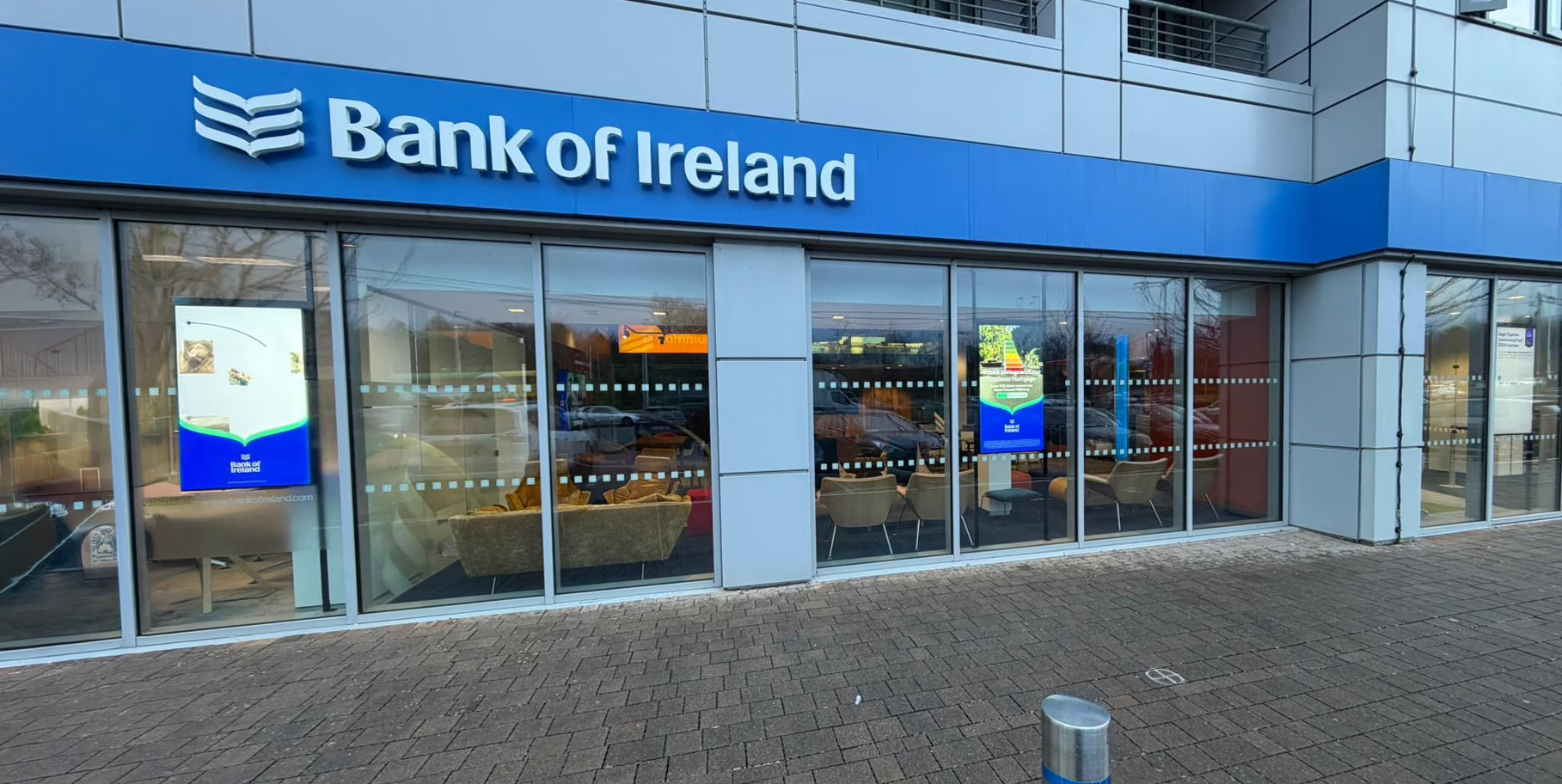
A pilot in-branch digital screen solution designed to inform, engage and lift the customer experience — window displays and street-facing visuals planned branch by branch, managed from one platform, and mocked up before a single bracket went on a wall.
A pilot built to be judged on evidence, and designed from the start so that what comes after it is a rollout rather than a rebuild.
The commitment
A pilot is still a live estate. It gets the same support arrangement as anything else we run.
Hour on-site response
Hour support, seven days
Platform for every screen
Surprises on install day
Pilot with purpose
Done properly, a pilot answers something the business cannot answer from a brochure.
Plenty of pilots are really just a small order with a cautious name on it. This one was set up to produce an answer: does a digital screen in a branch actually change how customers engage, does the content stay current once the novelty wears off, and can the estate be operated day to day without becoming somebody’s second job.
That framing changes the specification. Hardware has to be representative of what a full rollout would use, not a cheaper stand-in. The content platform has to be the real one. And the support arrangement has to be the one that would scale, because a pilot supported by goodwill tells you nothing about what happens at two hundred sites.
Everything was built so that a decision to go wider is an extension of what already exists rather than a fresh start.
Engage. Inform. Connect.
A branch window is one of the most valuable pieces of advertising space a bank owns, and for most of the week it is doing nothing.
High-brightness displays facing the street, readable through glass in daylight, turning a quiet frontage into something people notice on the way past.
Key information and announcements reaching customers in the branch at the moment they are standing in it, rather than in a leaflet holder.
Promotion of products, services and community initiatives, changed as campaigns change rather than when somebody reprints a poster.
Dynamic, relevant content that makes the time spent waiting feel shorter and the branch feel current.
Before anything is installed
Mockups are produced for each location, so the decision is made against a picture of that branch rather than against a specification sheet.
Nobody can picture a screen from a model number and a set of dimensions. So before a location is signed off, we produce a visual of the screen in that actual frontage — the real window, the real proportions, the real sightline from the footpath.
It settles the arguments that otherwise happen after installation, when they are expensive. Is it too big for that window. Does it block the light into the banking hall. Does it read from across the street or only from directly in front. Every one of those is cheaper to answer in an image than in a bracket.
Every building is different
Bank branches sit in everything from a modern retail unit to a protected nineteenth-century frontage. The estate has to look consistent anyway.
Window sizes differ. Glazing differs. The depth behind the glass differs, and so does what the building will allow to be fixed to it. A specification that works on one high street unit is simply not installable two towns over.
So each site is surveyed on its own terms and the hardware is chosen to suit it, while the thing the customer sees — the brand, the content, the quality of the image — is held constant. That is the difference between an estate and a collection of installations.
Brand consistency and support
What keeps a pilot working after the first fortnight.
One platform, every screen. Consistent messaging across all pilot locations, with content updated quickly and efficiently rather than site by site.
The same look in every branch. Templates and central control mean a local update cannot quietly drift away from the brand.
System health checks and automated alerts. We monitor the estate so the branch does not have to notice a fault and report it.
Applied remotely. The platform stays current without an engineer visiting to press a button.
Engineers nationwide, on site within 24 to 48 hours. With local stock held for fast hardware replacement rather than a wait on parts.
Scheduled rather than reactive. Issues found early, which is how downtime is reduced instead of merely responded to.
Why partner with us
The hardware is the easy part to evaluate. These are the parts that decide whether a rollout is worth doing.
Proven experience delivering digital solutions in complex, customer-facing environments where the space stays open while we work.
Reliable systems and strong service levels, so disruption to a trading branch is kept to the minimum the job allows.
Collaborative and responsive, aligned to what the business is trying to achieve rather than to what is easiest to install.
Energy-efficient hardware and responsible operational practices, which matters more on an estate that runs every day than on a single screen.
Built for the future
Flexible and scalable, designed to evolve with the business and with the technology behind it.
The point of doing a pilot properly is that the second phase is not a second project. The platform, the content templates, the support model and the survey process all scale as they are — which means a decision to go wider is a decision about how many, not about how.
That is what makes it a foundation for digital transformation rather than an experiment that has to be repeated.
More like this
Same discipline, different frontages.
Tell us how many sites you are considering and what you want the pilot to prove. We will come back with what it would take, and with a mockup of one of your own buildings so you can see it before you decide anything.


