
Talk to an Expert
Client Success Story

Digital menu boards, freestanding kiosks and sun-readable window displays across sites throughout Ireland — on one network, since 2017. The boards change with the time of day and with the weather outside the door.
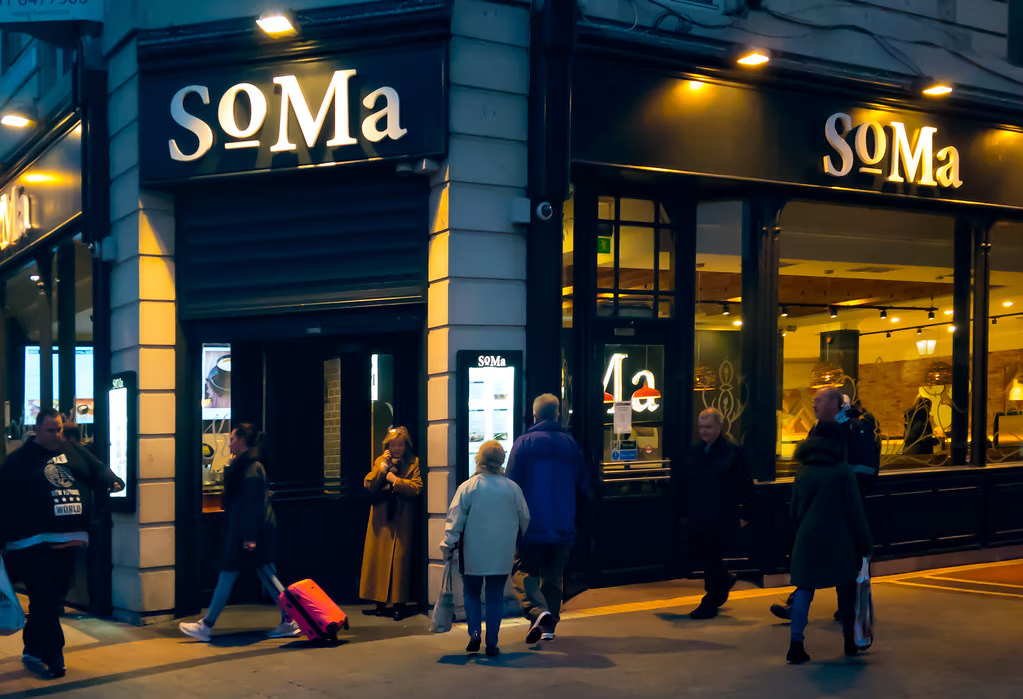
Nine years of continuous work across a food service estate that changes its offer twice a day.
By the numbers
Four figures that say more about a signage project than any photograph does.
Years running
Display formats
Content triggers
Site visits to change a menu
The brief
Food service has a problem most retail does not. The offer moves during the day, not just during the season.
Breakfast comes down at eleven and lunch goes up. Specials change daily. Prices move whenever supply does. On printed boards every one of those changes is a design job, a print job, a courier and somebody on a chair with a screwdriver.
Multiply that across sites the length of the country and it stops being an inconvenience and becomes a reason the boards are simply left wrong. Out-of-date boards cost more than they look like they do — they slow the queue, they cause refunds, and they quietly train regulars to stop reading them.
Kylemore needed boards head office could change in minutes, that staff on site could work without a training day, and that would still be readable through a south-facing window at two in the afternoon.
What went in
Each one solves a different problem in the same building. They share a network, a content library and a single place to change them.
Behind the counter, in HD, laid out to read from the back of the queue. Dayparted, so the right menu is up without anyone remembering.
Out in the concourse where people decide whether to join the queue at all. Offers and campaigns rather than the full menu.
High-brightness screens built to hold up against daylight in a shopfront, where an ordinary television is grey by mid-morning.
The detail
Most case studies stop at “we installed digital signage”. This is the part that is useful if you are weighing up the same job.
Behind the counter, above the servery. Full menu, prices, allergens, with breakfast and lunch dayparted. Commercial-grade panels rated for all-day operation rather than consumer televisions.
Concourse and entrance. Offers, promotions and daily specials. Moves with the floor plan, so nothing is fixed into the building.
Shopfront glass, street-facing. High-brightness and sun-readable, so the offer still reads in direct daylight.
Every screen, every site. Screens connect back to one locally hosted CMS rather than a player per site that somebody has to visit.
Across all three formats. Built by our studio or by Kylemore, on templates, so a price change takes a minute and still looks like the brand.
From 2017 onward. End-user training on every site, plus a long-term maintenance and warranty package behind the hardware.
The part nobody else does
The screens are tied to live weather for the site they stand in. When the temperature falls, hot drinks move up the running order. When it rises, cold drinks and ice cream take the slot instead.
It sounds like a gimmick until you watch it work. The offer on the screen matches what the person walking in actually wants, on the day, without a manager having to notice the weather and remember to do something about it. That is the difference between a screen that displays a menu and a screen that sells.
On site
Photographs taken on the day, in the buildings they are still working in.
After the install
A screen system only one person understands stops being used the week that person goes on holiday.
Every site got hands-on end-user training, so the staff who actually change a special can do it themselves without ringing anyone. Behind that sits a long-term maintenance and warranty package.
Nine years in, that is the reason the estate is still running rather than a set of dark screens somebody stopped updating in year two.
The result
The measure of a signage project is not what it looked like on the day it went in. It is whether the screens are still right two years later, and whether the client keeps buying more of them.
Kylemore has done both. What started in 2017 has grown format by format and site by site, on the same network, the same CMS and with the same team behind it. Menus change from a desk. Specials go up in the morning. The weather does the rest.
“A short line from Kylemore about what the screens changed day to day.”
Name, role — Kylemore Services GroupMore like this
Same kit, different buildings.
Tell us how many sites you have and what the offer does during the day. You will get a straight answer about what it takes to run them all from one screen.